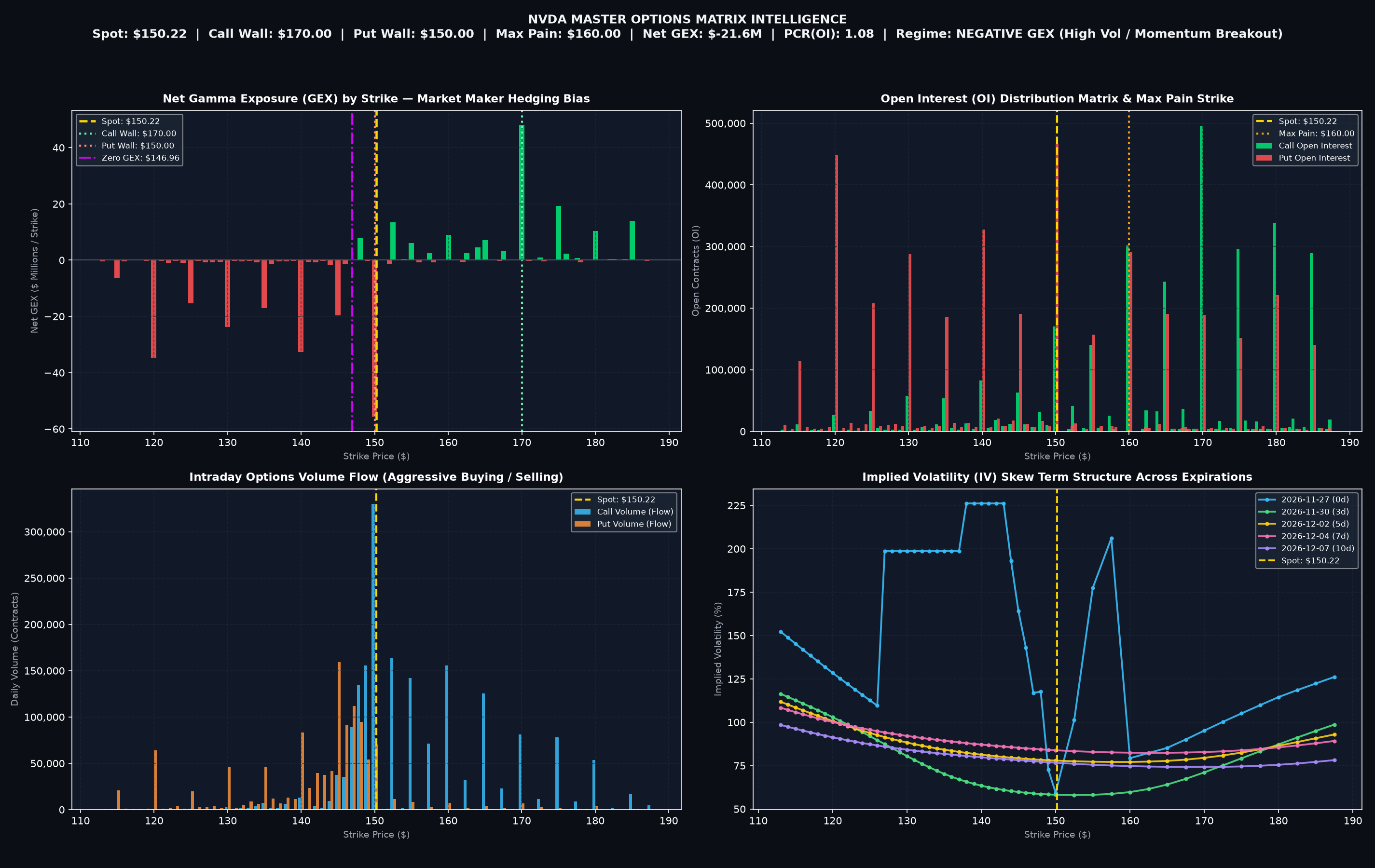
🧱 Why the Call Wall is a CEILING (Dealers Sell Stock)
The Call Wall is the strike price where the most Call contracts are open. Retail buys calls; Market Makers sell them.
To stay delta-neutral, dealers buy stock shares as price rises.
Why it halts rallies: Once price reaches the Call Wall strike, call buyers begin closing calls to bank profits.
The instant calls are closed, dealers no longer need their hedging shares and dump millions of shares of actual stock back into the open market, creating a rigid ceiling.
Dealer Action: Heavy Share Dumping into Rallies
🛡️ Why the Put Wall is a FLOOR (Dealers Buy Stock)
The Put Wall is the strike price where the most Put contracts are open. Speculators buy crash protection; Dealers sell those puts.
To hedge short puts on a dropping market, dealers are short stock shares.
Why it halts drops: When price hits the Put Wall strike, put owners monetize their gains.
As puts are closed, dealers must buy back their short stock hedges in the open market to close their books. This massive computerized buyback creates a violent trampoline bounce.
Dealer Action: Heavy Share Buybacks into Dips
⚠️ What is Zero GEX & Why Volatility Explodes Below It
The Zero GEX Line is the exact price pivot where dealer Net Gamma flips from positive (+) to negative (-).
Above Zero GEX: Dealers are long gamma. They buy dips and sell rips $\rightarrow$ volatility is squashed, price mean-reverts.
Below Zero GEX: Dealers flip short gamma. They must sell as price falls and buy as price rips $\rightarrow$ dealer shock absorbers vanish, causing rapid cascade selloffs.
Inflection: Mean Reversion ⟷ Breakout Cascade
⏳ How Time Decay ($\Theta$) & Charm Impact Price
Option Delta is not static over time. Charm ($\text{Charm} = -\partial \Delta / \partial t$) measures how delta decays as expiration nears.
As out-of-the-money options lose value to time decay, dealers who bought stock to hedge them are forced to unload those shares into the market even if the stock price doesn't move!
This creates an inescapable gravitational pull pulling the stock directly toward Max Pain as Friday 4:00 PM approaches.
Charm Hedging: Gravitational Pull toward Max Pain
📐 Are Walls Only at $5 Levels? (Why They Are ZONES)
No! Near-term NVDA strikes are spaced at $0.50 and $1.00 intervals, and SPY has $1.00 strikes.
More importantly, walls are never razor-thin lines; they are ABSORPTION ZONES:
When an institution buys a $150 call paying $2.20, their break-even is $152.20. Market makers don't dump shares only at $150.00; they hedge continuously across the $149.20 to $150.80 cushion band.
Furthermore, Zero GEX ($147.50) is a mathematical inflection point that can be any exact decimal.
Real World: Supply/Demand Bands, Not Razor Lines
💥 When Does Something BIG Happen? (Explosion Triggers)
A massive fluctuation occurs ONLY under 3 specific structural triggers:
1. Trapdoor Breach: Spot breaks below Zero GEX $\rightarrow$ dealers flip short gamma and begin aggressively dumping shares into the fall.
2. Gamma Squeeze: Spot breaks above Call Wall ($150.80) on heavy volume $\rightarrow$ dealers get caught short delta and panic-buy stock.
3. Volume Surge (UOA): Intraday volume surges $> 2\times$ Open Interest, overpowering the dealer's inventory dampener.
Breakout Rule: Volume Surge + Zero GEX / Wall Breach